
Last updated October 16, 2026
 Water damage drying
 Fire & smoke cleanup
 Mold remediation
 Storm response
 Sewage cleanup
 Reconstruction
Free visual inspection and a written scope of work before any mitigation begins - photos, moisture readings, and drying logs go in your claim file
The scope we write is the scope we bill. Anything new gets shown to you, in writing, before we touch it.
Get your free estimateHow to Hire a Damage Restoration Contractor in Fresno: A Step-by-Step Guide
Storm chasers, contractors who follow emergency calls and insurance referrals rather than earning local trust, account for the majority of restoration complaints filed with California’s CSLB each year. Fresno homeowners rarely know how to spot them until the damage is done twice: once by the water or fire, and again by the contractor who overpromised and underdelivered. This guide walks you through a calm, sequential hiring process that works even at 2 a.m. with water still on the floor, and you can find The Complete Guide to Damage Restoration in Fresno for deeper context on every step. You’ll learn what to ask before anyone touches your home, how to verify credentials in under two minutes, and what language in a contract signals trouble ahead.
Quick Answer
To hire a damage restoration contractor in Fresno, verify their California Contractor’s License on the CSLB website, require a written scope of work and price before any labor begins, confirm their drying plan is based on moisture readings rather than visual guesswork, and ask directly whether they will coordinate with your insurance adjuster or handle the claim themselves. A legitimate contractor will welcome these questions, answer them in plain language, and put every promise in writing. If they resist any of these steps, that resistance is your answer.
Restoration work we handle
Table of Contents
- Step 1: Verify the California Contractor’s License Before Anything Else
- Step 2: Demand a Written Scope and Price, Not a Verbal Estimate
- Step 3: Ask How They Measure Moisture, Not Just Where They See It
- Step 4: Clarify the Difference Between Coordinating Insurance and Complicating It
- Step 5: Spot Fresno-Specific Red Flags Before They Cost You
- The Five Questions to Ask Before Any Contractor Touches Your Home
- Contract Language That Signals Upcharges Are Coming
- How This Process Works When It’s 2 A.M. and Water Is Still Rising
Step 1: Verify the California Contractor’s License Before Anything Else
In Fresno, a damage restoration contractor performing any work over $500 in labor and materials must hold a valid California Contractor’s State License Board (CSLB) license. This is not a suggestion. It is state law under California Business and Professions Code Section 7028, and unlicensed contracting is a misdemeanor in many cases. The problem is that storm chasers know most homeowners will not check, especially not at 3 a.m. with a soaked living room carpet and a panicked spouse asking what happens next.
The verification process takes under two minutes. Go to the CSLB website, click “Check a License,” and enter either the contractor’s name or license number. You are looking for three things:
- Status: The license must say “Active.” A suspended or expired license means the contractor cannot legally work in California.
- Classification: Restoration work typically falls under “C-61” or “D-64” (limited specialty) or a general building contractor classification with relevant certifications. A painter holding a C-33 license is not licensed to perform water damage restoration, even if their cousin’s truck says “restoration” on the door.
- Workers’ compensation insurance: The CSLB will show whether the contractor carries workers’ comp. If they have employees and no workers’ comp, a technician injured in your home becomes your liability. This is not a theoretical risk. We have been called to homes in Fresno where the previous contractor’s uninsured crew member slipped on wet flooring, and the homeowner was left dealing with the aftermath.
We are independently owned and operated in Fresno, working to the Cedarwell Care Promise, and every technician who walks through your door carries credentials you can verify. But the principle stands regardless of who you hire: check the license first, every time, no exceptions. If a contractor hesitates to give you their license number or deflects with “we’re fully licensed, trust us,” that is not an answer. That is a red flag wearing a polo shirt.
Step 2: Demand a Written Scope and Price, Not a Verbal Estimate
The single most common complaint we hear from Fresno homeowners is some version of: “He told me it would be around four thousand, and the final bill was nine.” The word “estimate” does the heavy lifting in that sentence. An estimate is a guess. A guess can be wrong in either direction, and in the restoration industry, guesses rarely come in under the final number.
What you need before any work begins is a written scope of work. This document should list, line by line, exactly what will be done: which rooms are included, what equipment will be placed, how long the drying period is expected to last, what materials will be removed versus dried in place, and what the total cost will be. A written price delivered before any work starts is not a courtesy. It is the only reliable way to know what you are agreeing to.
At Tidemark, we deliver a written price before the first piece of equipment comes off the truck. Shoe covers go on at the door. Drop cloths cover the floor before the first fan is unloaded. The number you see is the number you approve, and the final invoice matches it. If a contractor in Fresno will not put their price in writing before starting work, you should not let them start work. It is that simple.
Step 3: Ask How They Measure Moisture, Not Just Where They See It
A tide mark is the line water leaves on a wall. It is the first thing our technicians look for on every job, because it tells us where the water reached, not just where it pooled. But finding the tide mark is only the beginning. Drying a home properly requires measuring moisture content in materials, not eyeballing damp drywall and declaring victory when the surface feels dry.
Here is what a professional drying plan looks like in a Fresno home:
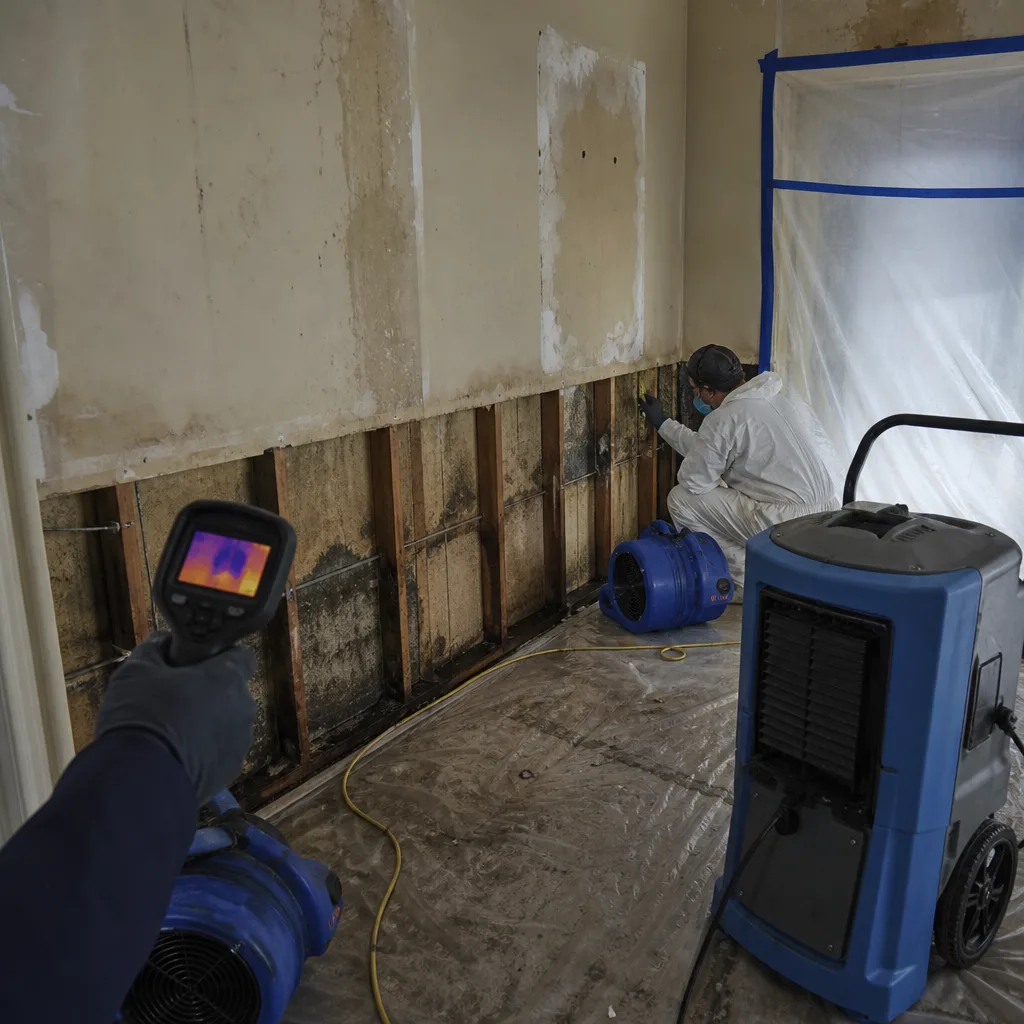
- Baseline moisture readings: The contractor uses a moisture meter to record readings from affected walls, flooring, and cabinetry before equipment is placed. These readings become the reference point.
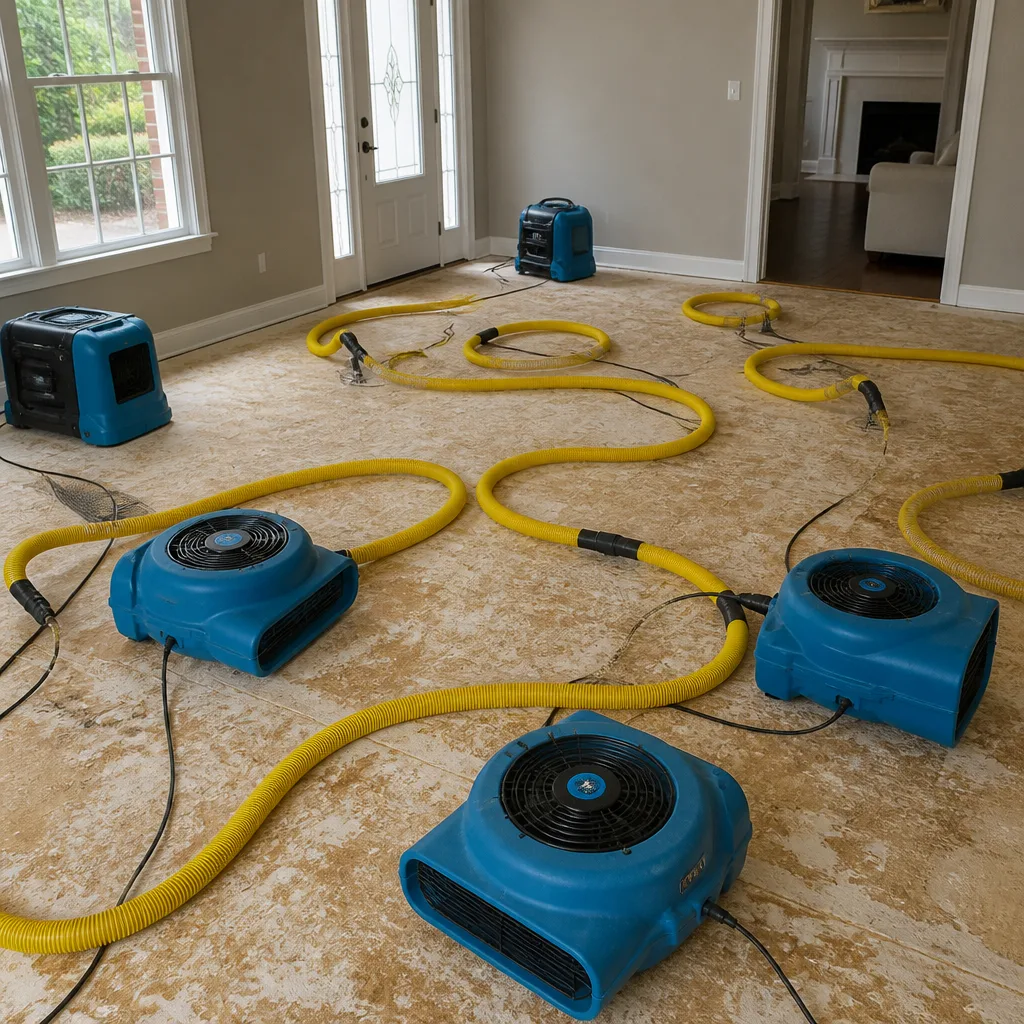
- Targeted equipment placement: Air movers and dehumidifiers are positioned based on where moisture actually is, not where it is most convenient to run extension cords. Professional-grade equipment from Dri-Eaz and Phoenix gives technicians precise control over airflow and humidity.
- Daily monitoring: Moisture readings are taken each day to confirm the drying curve is trending downward. If the numbers plateau, the drying plan adjusts, whether that means repositioning equipment, adding a dehumidifier, or addressing a hidden water source.
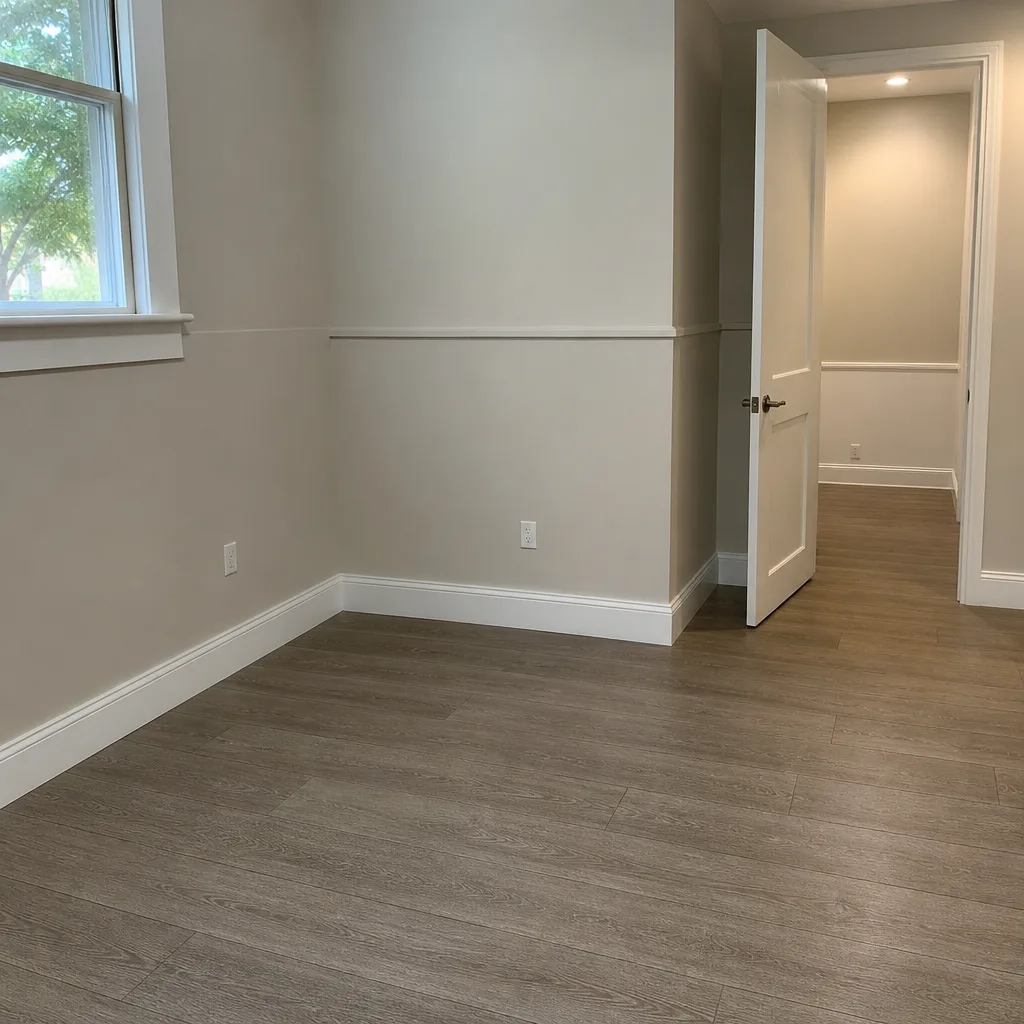
- Documented completion: The job is not “done” when the technician feels like leaving. It is done when moisture readings confirm the affected materials have returned to their dry standard, with a photo of the clean-up shared before the crew leaves.
Ask any contractor bidding your job: “What moisture meter do you use, and what readings are you getting right now?” A professional answers with numbers. A storm chaser answers with a shrug and something about how “it looks pretty dry in here.” Visual guesswork leaves water trapped inside wall cavities, and in Fresno’s hot summers, trapped moisture becomes mold faster than most homeowners realize. The contractor who measures is the contractor who knows when the job is actually finished.
Step 4: Clarify the Difference Between Coordinating Insurance and Complicating It
“We work directly with your insurance” is the most misleading sentence in the restoration industry. It sounds reassuring. It usually means something far less helpful: the contractor will bill your insurer directly, and you will have limited visibility into what is being charged, approved, or disputed. The phrase sounds like advocacy. Too often, it is the opposite.
What you actually want is a contractor who coordinates with your insurance company while keeping you informed at every step. The difference is not semantic. A coordinating contractor documents the damage with photos, writes a scope that matches what your policy covers, communicates with the adjuster, and gives you a copy of every document before it goes anywhere. A complicating contractor handles all of it behind closed doors, submits inflated line items, argues with the adjuster without telling you, and leaves you holding a denied claim or a surprise balance.
Here are the questions to ask:
- “Will I see the scope of work before it goes to my insurance company?” The answer must be yes. No exceptions.
- “Will you bill my insurer directly, and am I responsible for any amount they don’t approve?” You need a clear answer about who pays what, and when.
- “Can you send me photos of the damage and the completed work?” Photo documentation is your protection if the claim is disputed later. We take a photo of the clean-up and share it before the crew leaves, every time.
- “Who speaks with the adjuster, and will I be copied on those conversations?” You are the policyholder. The claim belongs to you. A contractor who treats you like a bystander to your own insurance claim is not coordinating. They are controlling.
In Fresno, where many homes are older and policies vary widely, this distinction matters more than in some coastal markets. Your adjuster needs clear documentation. Your contractor needs to provide it. And you need to stay in the loop.
Step 5: Spot Fresno-Specific Red Flags Before They Cost You
Every market has its own restoration headaches. Fresno’s are shaped by the climate, the housing stock, and the way storm chasers move through the Central Valley after heavy rain years, which is why our Seasonal Damage Restoration Care for Fresno: Year-Round Homeowner’s Guide breaks down what to expect each season. Here is what to watch for locally:
- High-volume referral networks: A contractor who appears at your door within an hour of a storm, saying they were “in the neighborhood” and noticed your roof tarp flapping, is almost certainly working a referral network. These networks sell leads, not quality. The contractor pays for the lead, which means the cost gets baked into your bill. Legitimate local contractors do not cold-knock after storms.
- Unlicensed subcontractors on mold remediation: Mold remediation in California requires specific training and licensing. Some Fresno contractors cut costs by subbing mold work to unlicensed day laborers with no IICRC credentials. In our experience, this is one of the most common shortcuts in the Central Valley, and it is one of the most dangerous. Ask directly: “Who will be doing the mold work, and can I see their certifications?” If the answer involves anyone who is not credentialed, walk away.
- Skipping California CSLB disclosure requirements: California law requires contractors to provide specific disclosures before starting work, including a written contract that spells out the work, the price, and the timeline. Some Fresno storm chasers skip the written contract entirely and ask for a signature on a blank authorization form. Do not sign a blank form. Ever. Under any circumstances.
- The “we can start tonight if you sign now” push: Urgency is a tool. A contractor who pressures you to sign immediately, before you have a chance to verify their license or review the scope, is not acting in your interest. Water damage does require prompt action, but twenty minutes spent verifying a license will not make the damage materially worse. A contractor who claims otherwise is selling fear, not restoration.
The Five Questions to Ask Before Any Contractor Touches Your Home
Whether it is 2 p.m. or 2 a.m., whether the water is from a burst pipe in Fresno’s Tower District or a washing machine overflow in Clovis, these five questions create a hiring process that works under pressure. Write them down. Put them on your phone. Ask them in order.
- “What is your California Contractor’s License number?” Write it down. Check it on the CSLB website before they unload a single piece of equipment. This takes under two minutes and eliminates the majority of unlicensed operators immediately.
- “Will you give me a written scope of work and price before you start?” If the answer is anything other than yes, the contractor is telling you they intend to surprise you later. You are not hiring a surprise.
- “What moisture readings are you getting right now?” A professional pulls out a moisture meter and shows you numbers. If they cannot name the tool they use or the readings they are seeing, they are guessing. Guessing does not dry a house.
- “Who will be doing the work, and are they your employees or subcontractors?” You need to know who is in your home. Background-checked, uniformed technicians are the standard. A rotating cast of day laborers in unmarked trucks is not. This matters for safety, for quality, and for your own liability.
- “Will you coordinate with my insurance adjuster, and will I see all documentation before it is submitted?” The answer tells you whether you are hiring a partner or a middleman. You want the partner who keeps you informed.
Contract Language That Signals Upcharges Are Coming
Some contracts are written to protect the homeowner. Some are written to protect the contractor’s margins at the homeowner’s expense. The language tells you which is which before you sign. Here are the phrases that should make you pause:
- “Time and materials, to be determined at completion.” This means you are signing a blank check. The contractor has no incentive to work efficiently, no incentive to keep costs down, and no obligation to tell you when the bill is climbing. Never sign this for restoration work.
- “Additional charges may apply for unforeseen conditions.” Unforeseen conditions do happen in restoration. A wall opened up may reveal more damage than anticipated. But the contract should specify a process for handling those discoveries: written notification, a revised scope, and your approval before additional work proceeds. If the contract just says “may apply,” the contractor has unilateral authority to spend your money.
- “Insurance proceeds assigned directly to contractor.” This is an assignment of benefits, and in California, it is a serious red flag in restoration contracts. It means the insurance company pays the contractor directly, and you lose leverage over both the claim and the quality of the work. Some contractors push this aggressively. Do not sign it.
- “Final invoice due upon completion, regardless of insurance approval.” This puts you on the hook for anything the insurer denies. A responsible contractor coordinates with your adjuster throughout the process and keeps you informed of what is approved, what is pending, and what the gap might be. A contractor who wants final payment regardless of insurance approval is telling you they do not care what your policy covers.
At Tidemark Water Damage Fresno, the written price you approve is the price on the final invoice. If conditions change, you hear about it in writing before any additional work begins. That is the Cedarwell Care Promise at work, and it is the only way we have ever done business.
How This Process Works When It’s 2 A.M. and Water Is Still Rising
Here is what actually happens when a pipe bursts at 2 a.m. in Fresno. Water is spreading across the floor. You are standing in it, or you are trying not to. Your phone is in your hand. Your family is asleep upstairs, or they are awake now because the sound woke them.
This is when the industry exploits pressure. Storm chasers know that a homeowner in crisis will not check licenses, will not ask for a written scope, will not compare bids. They count on panic to bypass the process. Your job is to remember that the process does not change because the clock says 2 a.m. It just moves faster.
- Call a live person. Not a voicemail. Not a callback queue. You need someone on the phone who can tell you what to do in the next ten minutes to stop the water, even if it is just turning off the main valve and moving valuables off the floor. Our phone is answered by a real person, 24 hours a day, every day.
- Ask the five questions while the crew is en route. License number. Written scope. Moisture readings. Who is doing the work. Insurance coordination. You can ask all five in under ten minutes on the phone, and a legitimate contractor will answer every one without hesitation.
- Get the written price before work starts. Yes, even at 2 a.m. A contractor can email you a scope of work from the truck. If they cannot, that is a problem. The technology exists. The only reason not to use it is because the contractor prefers ambiguity.
- Protect the family while the work happens. Shoe covers at the door. Drop cloths on the floor. Pet-safe products where there is a choice. Lower-decibel settings during school hours and nap time. These are not luxuries. They are the difference between restoration that respects your home and restoration that adds a second problem on top of the first.
Water damage does not wait for business hours. Neither do we. But speed does not mean skipping the safeguards. If anything, speed makes the safeguards more important, because the decisions you make at 2 a.m. are the ones you live with for months afterward.
Common Mistakes to Avoid
- Signing an authorization form without a written scope. The authorization form gives the contractor permission to start work. Without a scope, “work” means whatever the contractor decides it means. This is the number one mistake we see in Fresno, and it is almost always followed by a bill the homeowner did not expect.
- Choosing the first contractor who answers the phone. Speed matters, but so does legitimacy. Twenty minutes of verification is not going to make your water damage materially worse. Hiring the wrong contractor can make it dramatically worse.
- Accepting “we work with insurance” as a substitute for “we coordinate with your adjuster.” The first is vague. The second is specific. Ask for specifics.
- Skipping moisture verification. A contractor who dries by eyeball is guessing. Guessing leads to mold, and mold leads to a second, more expensive remediation six months later. In Fresno’s heat, that timeline compresses.
- Ignoring subcontractor questions. If a contractor sends unlicensed subcontractors into your home, you are accepting liability for anyone who gets injured on the job. Ask who is doing the work. Verify it.
- Letting pressure replace process. The storm chaser’s entire business model depends on the homeowner feeling too overwhelmed to ask questions. The questions are not burdensome. They are protection.
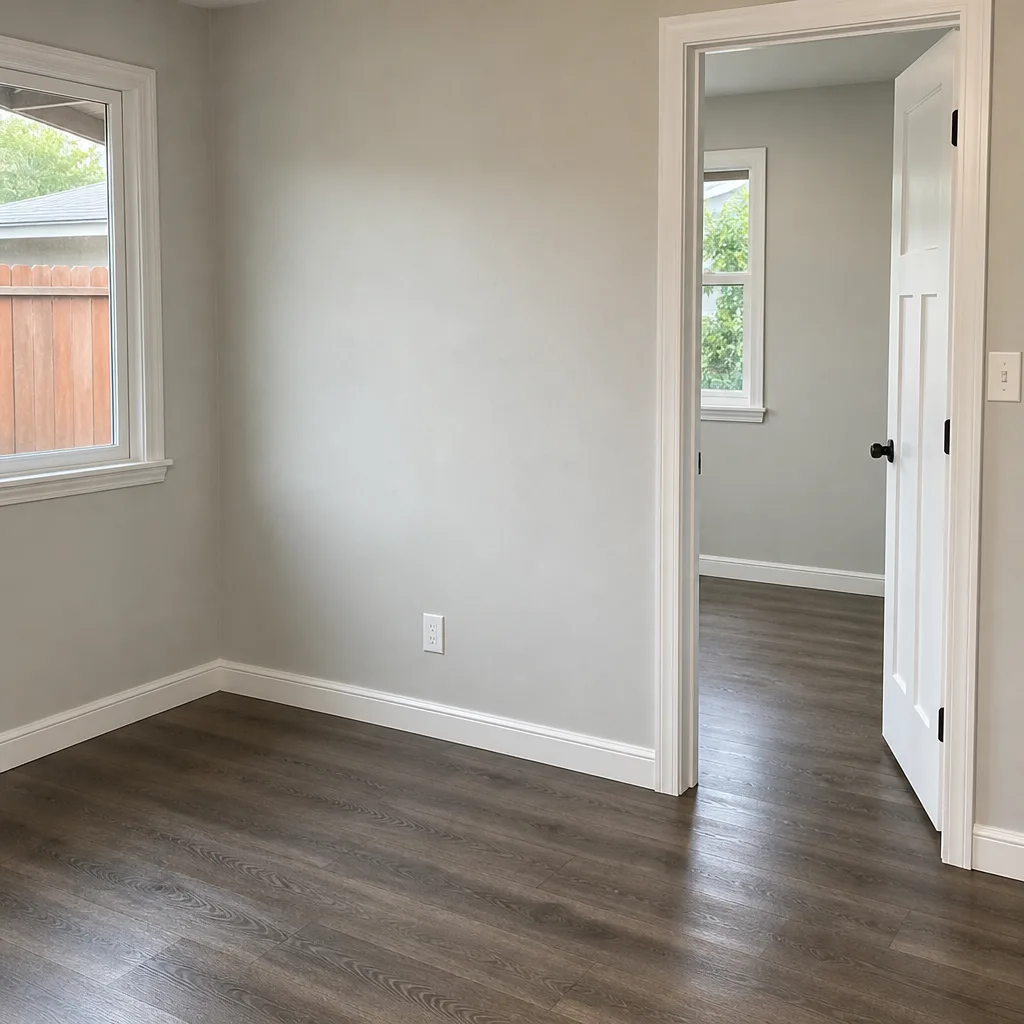
See the difference
 Before
 After
After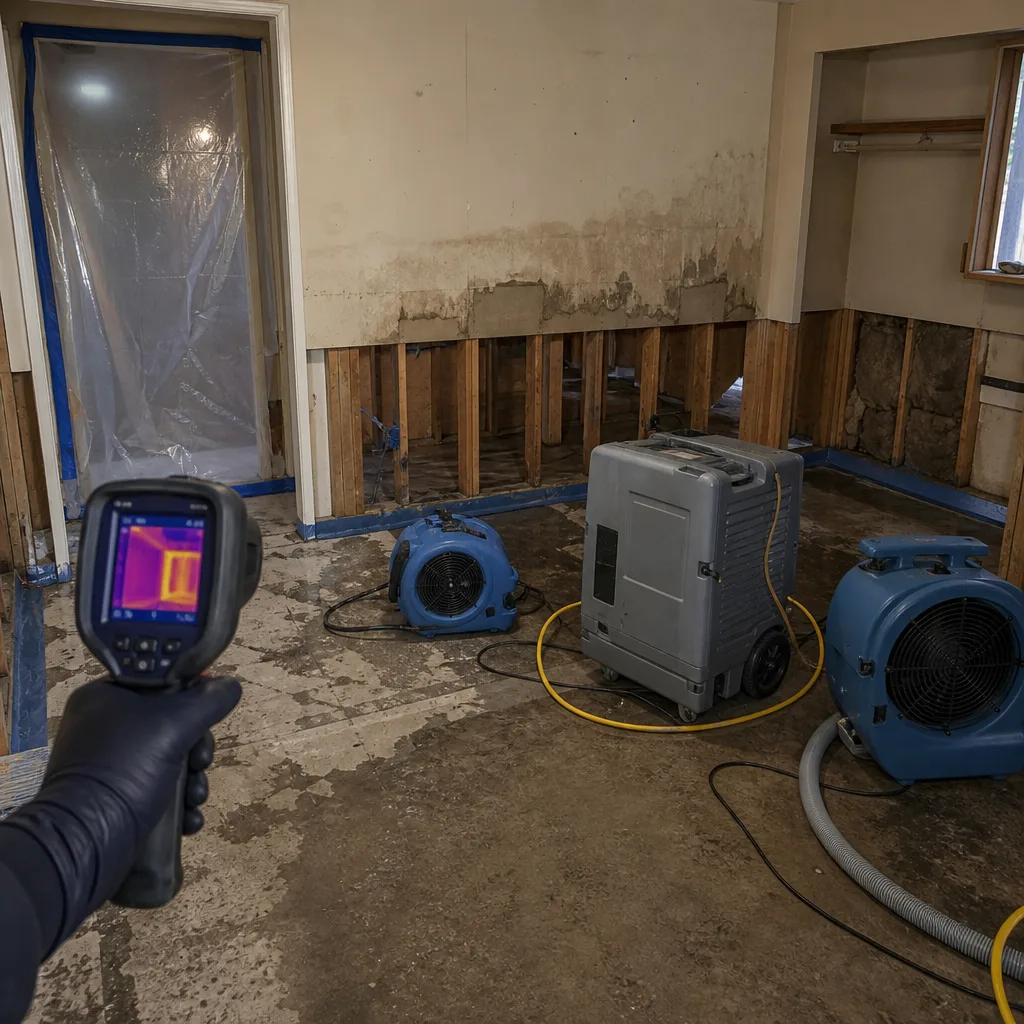 Before
 After
After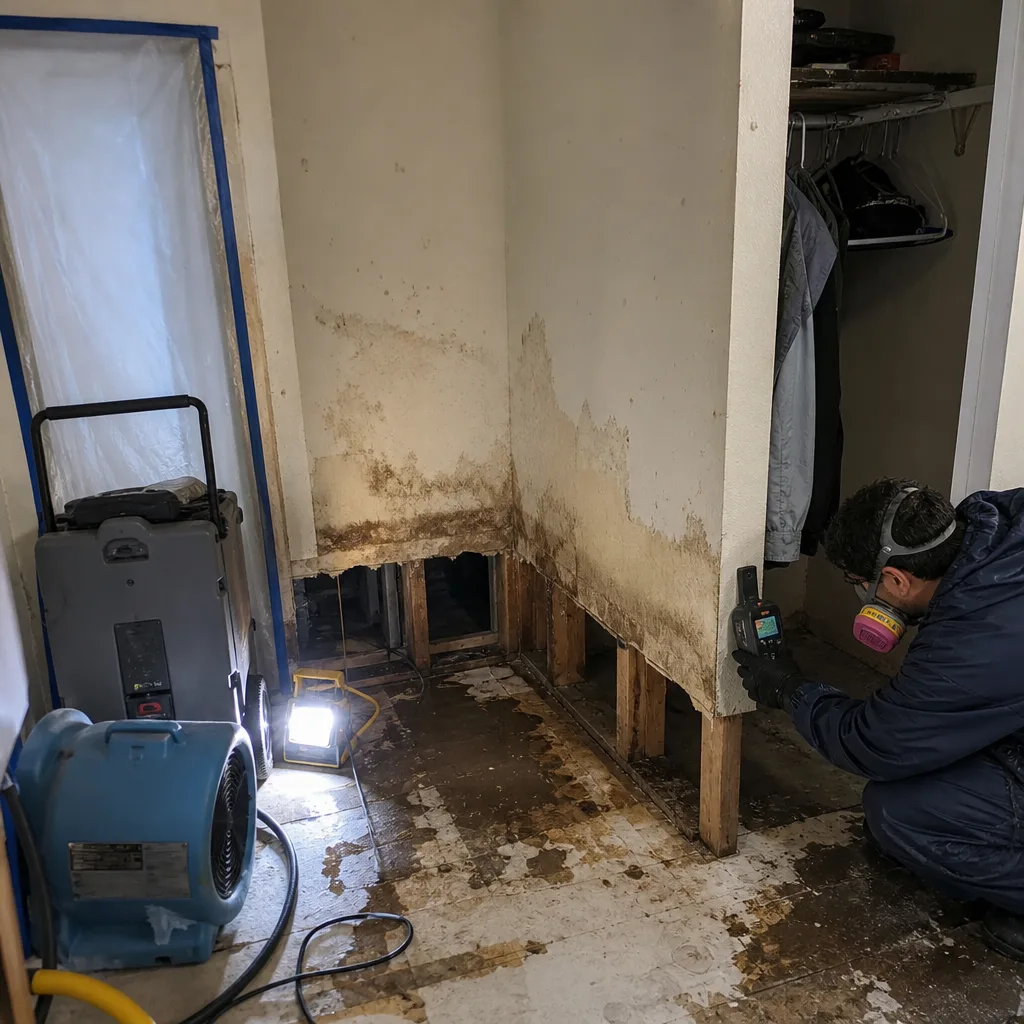 Before
 After
AfterWhen to Call a Professional
Some damage is too extensive, too hidden, or too hazardous for a homeowner to handle alone. Call a professional if the water has seeped into walls or under flooring, if the affected area is larger than a single room, if you smell must or see visible mold, if your electrical panel or outlets were exposed to water, or if the damage resulted from sewage or contaminated water. Fire and smoke damage always require professional assessment, as smoke particles penetrate materials far beyond the visible burn area. The same goes for any situation where you have already filed an insurance claim, because the insurer will expect professional documentation. Tidemark Water Damage Fresno offers free estimates in Fresno, so calling (559) 354-1680 costs you nothing and gives you a clear picture of what you are dealing with.
Frequently Asked Questions
Go to the California Contractors State License Board website, click “Check a License,” and enter the contractor’s name or license number. You are looking for an “Active” status, a classification that matches the work being performed, and confirmation that the contractor carries workers’ compensation insurance if they have employees. The entire process takes under two minutes and eliminates most unlicensed operators immediately.
A legitimate restoration contract includes a line-by-line scope of work, a written total price, the rooms and materials covered, the expected drying timeline, the type of equipment that will be used, and a clear process for handling unforeseen conditions with written approval before additional work begins. If the contract says “time and materials, to be determined at completion,” do not sign it. Call (559) 354-1680 for a written price before any work starts.
Response times vary by company and time of day. At Tidemark Water Damage Fresno, our phone is answered by a live person 24 hours a day, and we dispatch crews to Fresno homes the same day, including nights and weekends. Water damage waits for no one, but the specific arrival time depends on where the crew is when you call and the severity of your situation. Call (559) 354-1680 and we will tell you exactly when we can be there.
Most homeowners policies cover sudden and accidental water damage, such as a burst pipe or an appliance overflow. Gradual damage, like a slow leak that has been going on for months, is often excluded. The best way to find out is to have a professional assess the damage, document it thoroughly with photos, and coordinate with your adjuster. We take photos of everything and share them with you before the crew leaves, which gives your adjuster clear documentation and gives you a record of exactly what was done.
Moisture meters measure the actual moisture content of walls, flooring, and cabinetry. A professional drying plan uses baseline readings, daily monitoring, and documented completion when the numbers confirm the materials have returned to their dry standard. If your contractor is not using a moisture meter and cannot show you readings, the job is not finished, no matter how dry the surface feels. Ask for the numbers.
If mold is present, cleaning alone is rarely sufficient. Mold roots penetrate porous materials like drywall and carpet padding, and surface cleaning leaves the roots behind to regrow. A professional mold assessment determines whether remediation is needed, and a credentialed technician will explain the difference based on what they find. In Fresno’s warm climate, mold can spread quickly, so if you see it or smell it, getting a professional assessment sooner rather than later is the cheaper path. Call (559) 354-1680 for an honest assessment.
The Bottom Line
Hiring a damage restoration contractor in Fresno does not have to be a gamble, and our more guides & resources can help you stay prepared year-round. Verify the license. Demand a written scope and price. Ask how they measure moisture. Clarify the insurance relationship. Watch for Fresno-specific red flags like referral networks and unlicensed mold subcontractors. The process takes twenty minutes, and it works at any hour of the day or night. The contractor who passes every step is the contractor you want in your home. The one who resists any step has told you everything you need to know. Trust the process, not the pressure.
Written by Rick Sumner, Owner at Tidemark Water Damage Fresno, serving Fresno since 2006.
For water damage restoration in Fresno, learn more about our Water Damage Restoration in Fresno services. If you’re dealing with mold, our Mold Remediation in Fresno page covers the assessment and remediation process in detail. For fire and smoke damage, see our Fire Damage Restoration in Fresno services. And if you’d like to see everything we do, start at our Tidemark Water Damage Fresno home page.